Welcome to My New Blogging Blurp
Unbalanced Studying
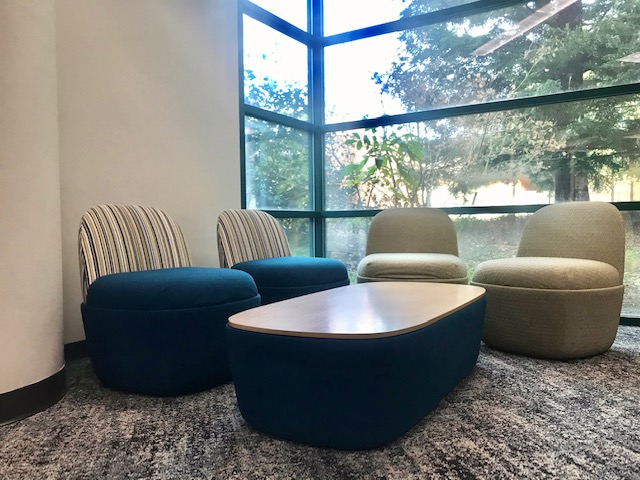
Studying in the library is a task in itself, from noisy study groups to loud conversations on the phone. The furniture provided should be beneficial for the students who utilize it. A tabletop physically lower than the seat you are sitting on does not make sense. The new round rolling chairs found in the Sonoma State library are visually cute yet slightly uncomfortable. The school provides a meager amount of stools or how most students use them, footrests. Then there are the tables placed in front of them. When working on a laptop, your screen should be angled where it doesn’t put a strain on your neck. Sitting on these chairs forces you to keep your laptop in your lap, causing you to look straight down. The backrest falls short as well, stopping halfway up your back leaving zero support for your already aching neck. These chairs are pleasant in theory, but longterm usability puts a toll on the body.
Electricity At Your Feet
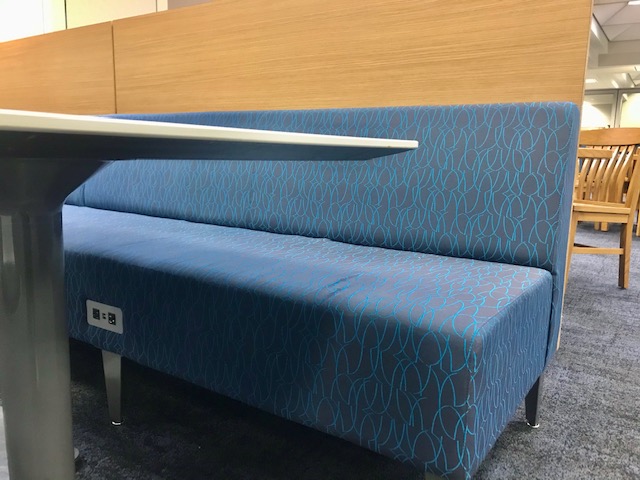
Technology is consistently changing, electricity flowing at your fingertips. Most people don’t leave their house without their phones. Throughout the day your battery drains eventually getting to the last percentage before you need to charge it. You are studying in the library and have a charger in your bag but not a power adapter. Found on the first floor of the library, long comfortable benches on the first floor provide a solution to just that. Each block of three benches has a total of four USB plugs as well ass three-prong plugs for your laptop. This shows adaptability to the fast-paced society we live in today. These benches are comfortable and provide many charging ports for the students studying in the library.
Hive Mind Power
Completing simple online tasks on your own time from anywhere to earn additional cash appears simple. Crowdsourcing can be a good use of downtime while earning a little for your pockets. With that in mind I researched about crowdsourcing technologies and tried some out. Sadly I was unable to create an account as an AmazonTurker, so I ended up emptyhanded. I then learned how crowdsourcing is also utilized academically for research. A game called fold.it explains the complexity of protein folding and the thousands of combinations they can contain. The puzzle game visually reminded me of an old retro game, where you had to move around amino acids to ‘untangle’ the string of proteins. Compensation was satisfied through knowing I could create an unknown protein or potentially help fight diseases. Playing the game was difficult at first since moving the amino acids would sometimes result in you further than your overall goal. I completed a few levels then realized that time had flown by, I have found a new way to spend my free time.
Screens and Poor Connection
I recently read a research paper called Re-Place-ing Space: The Roles of Place and Space in Collaborative Systems. This paper talks about the understanding of an environment’s use of space and how that differs from a place. From what I understood space is more along the lines of a room which can be used for many different things or where things are located, while a place is dedicated to a specific use or behavior which carries a social meaning. This sense of space and place can be applied to students’ current learning situation with social distancing in place. Learning entirely through Zoom has been a learning experience in itself, but is a significantly useful tool for professors of all grades. Compared to face-to-face learning, I prefer learning remotely due to the comfortability aspect. Wearing pajamas to class and not being judged is a huge bonus for me. Before the quarantine, I would be required to show up to class diligently in respectable clothing and was expected to be actively ready to learn. When attending Zoom lectures students are still expected these things, but students have even more control over the participation aspect. I found that many students keep their cameras off and microphones muted while attending zoom lectures. While it is my choice to turn on my camera and unmute my microphone, many students use this power during lectures to not participate. In a classroom, a professor can make eye contact and can call on students which puts pressure on them to participate. Professors no longer have this power when teaching through an online platform like Zoom. Through online learning, students also lose the mentality and experience of learning in a space with other academics. For me, this has resulted in a decrease in motivation to do day to day activities including school work. In conclusion, I believe online learning is necessary during these circumstances but is impacting the mentality and motivations of myself and my peers.
Sketching With a Guiding Hand
Doodling is an activity done by everyone from amateurs to experts both young and old. Tracing shapes as a guide can be very helpful to those who are not the most gifted artists, which is how I originally learned how to draw. Traditionally artists crafted artwork on physical paper, but more current digital platforms have become more popular. Today I read a research paper submitted to CHI, a Human-Computer Interaction Conference, on Accessing a Continuum of PHysically Assisted SKetchING. The title intrigued me, so I wanted to learn more. This paper explores how using active force feedback can help guide users with some digital support while sketching on paper. The authors developed a pen that physically guides users while still allowing creative expression in originality and authorship. Users can set shape constraints such as circles or triangles or lines. Based on the chosen restriction, the device will guide the user’s hand on the paper. Exploring the use of active force feedback, the creators implemented a pressure detector. Using that detector allows users to choose the amount of assistance given by the guiding system. This application is the physical development of guides found on electronic devices or tracing a physical object. I found this paper interesting in its adaptive guide system and how the device improved productivity while allowing the creativity of users on physical paper. The creators recognized their user audience as children, hobbyists, or recovering stroke patients who might want to draw a straight line, correctly size shape proportions, or figure out the perspective of a shape. The need for physical control is best accomplished with the traditional pen and paper but possesses the challenge of maintaining constant proportions when free handing. I enjoyed the research explored within this paper, but I had one question about the physical aspect of the device.Does the physical size of the pen create usage restrictions for users with smaller hands? Also, does the orientation of the motor restrain those who use their left hand to write or draw? Other than those two concerns, I would be interested in the device and would invest in my own.
Kianzad, S., Huang, Y., Xiao, R. and E. MacLean, K., 2020. Phasking on Paper: Accessing a Continuum of PHysically Assisted SKetchING. [online] Available at: <https://dl.acm.org/doi/abs/10.1145/3313831.3376134>.
 Kiyoko's World